
Western Wisdom Journey



JOURNEY OF WESTERN WISDOM
It is extremely challenging to organize and classify the immense measure of philosophical thought with its various branches and sub-branches into distinct time periods. Being too stringent with timeline obscures the flow of development of a particular school of thought. Associating a particular philosopher with one school of thought or branch or philosophy fails to capture the essence of maturation of the doctrine. One should bear in mind that there is considerable overlap in the life of various philosophers and the development of concepts and doctrines across the mentioned eras.
The Western Knowledge System can be broadly classified into three main eras – Ancient, Medieval and Modern
- Ancient Era is divided into Pre-Socratic (7th century BCE -5th century BCE) and Post Socratic (5th century BCE – 6th century CE)
- Medieval Era is divided into Pre-Renaissance (6th century CE – 14th century CE) and Renaissance (14th century CE – 17th century CE)
- Modern Era is divided into Age of Reason (17th century CE), Age of Enlightenment (18th century CE) and Post-Kantian (19th century – till date)
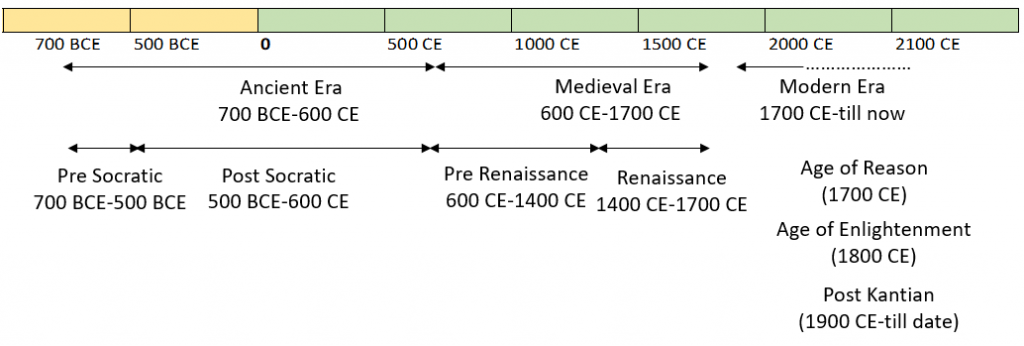
Ancient Era (700 BCE – 600 CE)
In the absence of definite records, it is difficult to determine an absolute starting point. The thoughts of the earliest philosophers were not documented and are known to us only through the citations, narrations and a little bit of textual expressions by Aristotle, Plato and from commentaries by other ancient philosophers and historians on these texts. The journey of western philosophy, therefore, commences with the speculations of the ancient Greeks.
Ancient Era is divided into Pre-Socratic (7th century BCE -5th century BCE) and Post Socratic (5th century BCE – 6th century CE).
Pre-Socratic period (700 BCE – 500 BCE)
‘Man is the measure of all things’ – Protagorus.
The term Pre-Socratic period would indicate philosophers who existed before Socrates. However, this is considered an approximate period, as some of the philosophers included in this period were contemporaries of Socrates (470 – 399 BCE). The philosophers of this period were concerned with investigating the natural world and questioned the existing beliefs. This exercise led to forming of various schools of thoughts – Milesian (Thales, Anaximander, Anaximenes), Pythagorean, Eleatic (Xenophanes, Parmenides, Zeno), Ionian (Heraclitus, Empedocles, Anaxagoras), The Atomists (Leucippus, Democritus), The Sophists (Protagorus, Gorgias, Hippias).
Post Socratic period (500 BCE – 600 CE)
‘An unexamined life is not worth living’ – Socrates.
In this period, Greek philosophical history reached its zenith. It comprised of the superlative doctrines of three prominent thinkers – Socrates, Plato and Aristotle. The main question of those times was preserving the intellectual knowledge and ethical concerns from materialism and scepticism. Through the inquiries and investigations of these wise men, foundations of various scientific and metaphysical concepts were laid. Schools of philosophy that developed during this period include – The Imperfectly Socratic (Euclid, Phaedo, Antisthenes Aristippus), Platonic (Xenocrates, Herclides), Aristotelian/Peripatetic School (Theophrastus, Demetrius, Andronicus), Stoics (Zeno, Seneca, Marcus Aurelius),Epicureans (Epicurus, Dionysius, Phaedrus, Lucretius), Sceptics (Pyrrho, Arcesilius, Agrippa), Eclectics (Posidonias, Demetrius, Antiochus). During this period, the natural and mathematical sciences developed independent of philosophical thought with significant contributions by Archimedes, Aristarchus, Ptolemy among others.
Medieval Era (600 CE-1700 CE)
Ancient philosophers discussed problems on the basis of intellect and reason only. With the advent of Christianity, the history of the world and along with it the history of philosophy was divided. Here onwards, for every question asked, there was to be a religious view which took references from Christianity and a rationalist or scientific view which refused to accept it. The religious temperament was predominant till 15th century. Fifteenth century onwards, the rationalist attitude prevailed despite the domination of Church.
Medieval Era is divided into Pre-Renaissance (6th century CE – 14th century CE) and Renaissance (14th century CE – 17th century CE)
Pre-Renaissance (600 CE – 1400 CE)
‘To one who has faith, no explanation is necessary. To one without faith, no explanation is possible.’ – St. Thomas of Aquinas.
This period began with the downfall of the Roman empire and eventually the unified civilized European world disintegrated. With decline in travel and trade, there was loss of communication and education and learning languished. Europe was thrown into the Dark Ages. All learning was centred on religion which led to development of the Patristic and Scholastic philosophies. Patristic Philosophy (1st to 6th century CE) included the Gnostics (Cerinthus, Saturnius), Manecheism (Manes), Anti-Nicene Fathers (Clement of Alexandria, Origen), Post-Nicene Fathers (Athenius, Gregory, St John of Damascus). Scholastic philosophy (9th to 15th century CE) included philosophers Erigena, Roscelin, Alexander of Hales, St. Anselm, the Mystics, The Pantheists, St Thomas of Aquinas, William of Ockam, Francis Bacon.
Renaissance (1400 CE- 1700 CE)
‘Give light, and the darkness will disappear of itself’ – Erasmus.
Renaissance means rebirth in French language. It was the time of revival of learning and wisdom after a long period of cultural and scientific stagnation. Social, political and intellectual transformations, which started in the 12th century led to breaking of old feudal structures. By the 15th century, there was revival of Platonic (George Plethon, Marcilio Ficino) and Aristotelian thought (Petrus Pomponatius, Jacopo Zabarella). Humanism (Erasmus, Thomas Moore, Francesco Petrarca, Lorenzo Valla) and Protestant Reforms (Martin Luther, Zwingli) developed. Art flourished. Machaivelli expounded political philosophy with the rising political individuality of states. Copernicus, Kepler, Galileo led the Scientific movement. The development of Science through methodical observations and experiments set the stage for a new era. The spectacular characteristic of this era was that Science and Philosophy parted ways.
Modern Era (1700 CE – till date)
This period in the history of philosophy began with the ascent of scientific thought and the decline of the authority of the Church. Improved methods of communication and accessibility to information stimulated learning and education. Concepts of liberty, identity, personal freedoms, natural rights developed. There occurred reorientation of thoughts regarding morality, social behavior, and free will.
Modern Era is divided into Age of Reason (17th century CE), Age of Enlightenment (18th century CE) and Post-Kantian (19th century – till date)
Age of Reason (1700 CE)
‘I think therefore I am’ – Descartes
This period in the history of philosophy began with the ascent of scientific thought and the decline of the authority of the Church. Philosophy dissociated from theology. There was increasing dependence on reasoning and intellect than religious beliefs, giving rise to Rationalism (Descartes, Leibnitz, Spinoza, Malebranche) and English Empiricism (Thomas Hobbes, Locke, Newton).
Age of Enlightenment (1800 CE)
‘Dare to know’ – Kant
This was a period of intellectual movement. There was further decline of the authority of Church. Established traditions were challenged. Politically, it was a time of revolutions and turmoil. In France, Britain and Germany, values of freedom, democracy and reason were voraciously promoted giving rise to philosophies of Idealism (Immanuel Kant), French Empiricism and Materialism (Voltaire, Montesquieu, Rousseau, Diderot), British Moralists (Adam Smith, Joseph Butler), British Empiricism (David Hume, George Berkeley).
Post-Kantian (1900 CE – till date)
‘Life is nothing until it is lived; but it is yours to make sense of, and the value of it is nothing other than the sense you choose.’ – Sartre
As a result of the strong influence of French and German philosophers, philosophy now acquired the language, traits and character of the nation or country of the thinker. Latin ceased to be the language of philosophy. Philosophy was identified as British, American, French, Italian etc. New socio-economic issues and scientific developments gave rise to Hegelianism (G.W.F. Hegal), Existentialism (Kierkegaard, Nietzche, Sartre, Camus), Logical Positivism and Analytical philosophy (Moore, Wittgenstein, Russell), Political philosophy, Naturalism, Utilitarianism, etc.
Going forward..
Rapid developments in all fields of Science and the expanding landscape of quantum physics have challenged the tenets of classical physics, giving rise to uncertainty regarding the material and objective reality. Copenhagen Interpretation (CHI) proves the quantum interconnectedness of the universe, recognizing consciousness as a fundamental feature of reality, blurring the lines between science and philosophy.