Journey Snapshot

JOURNEY SNAPSHOT
Cultures across the world have passed on their respective treasures of knowledge over centuries and generations either through written documentation or through oral transmission.
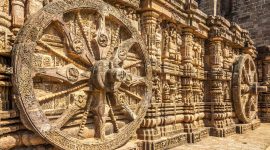
The vast knowledge repository of the Indian civilization is around 4500 years old. This ancient knowledge has been disseminated, uninterrupted over centuries, by generations of scholars, teachers, narrators, and storytellers, through the oral tradition. This system of oral continuity was maintained even after the documentation of texts started. India has one of the oldest and largest collection of manuscripts anywhere in the world, many of which are now lost and extinct. The ancient primary texts did not give much information about the authors or regarding the prime propagators of various doctrines. Additionally, these texts were composed in various Indian languages across diverse locations, and their manuscripts were spread across the country in different traditional schools, libraries, monasteries, temples, private collections etc. This made the task of determining the periods of composition of these ancient texts exceedingly difficult.
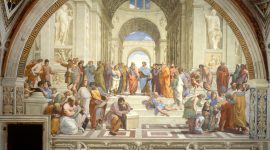
Western knowledge system is relatively recent and is deeply rooted in the philosophy of Ancient Greece and the Renaissance. As against oral transmission of Indian traditional knowledge system, the knowledge in the Western world was transferred mainly through written records and detailed documentation. Hence, determining the time periods of various authors and disciplines of knowledge is far less complicated.
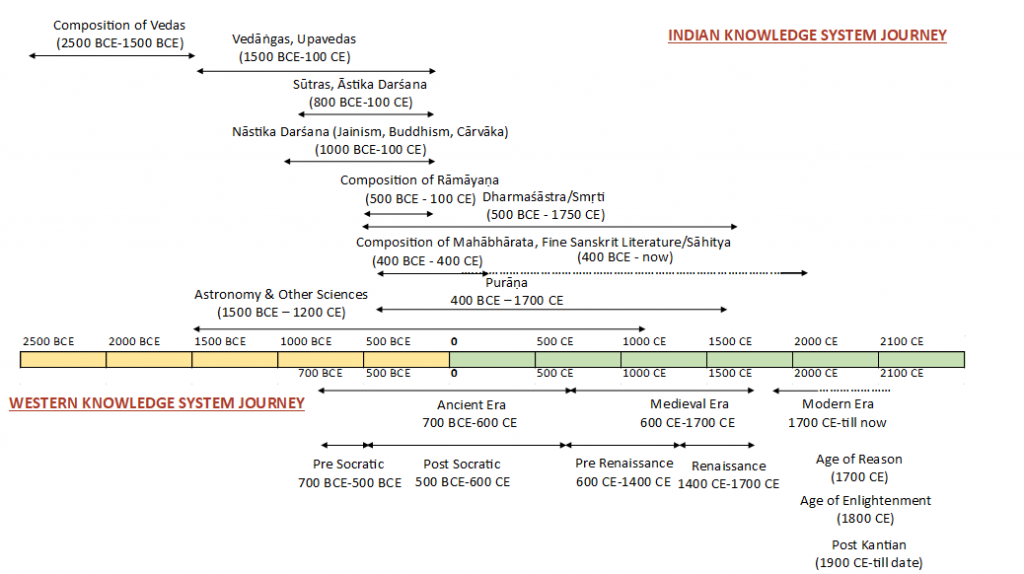
The diagram below depicts the chronological development of the Indian and Western knowledge system. The periods of compositions of various Indian scriptures are based on the best approximation.