
Yuga Chronology
Excerpt from the book ‘The Holy Science’ by Swami Sri Yukteswar Giri.
This Kaivalya Darsanam (exposition of Final Truth) has been written by Sri Sri Swami Sri Yukteswar Giri. At the request in Allahabad of the Great Preceptor (Mahavatar Babaji) near the end of the 194th year of the present Dwapara Yuga, this exposition has been published for the benefit of the world.
A short discussion with mathematical calculation of the Yugas or ages will explain the fact that the present age for the world is Dwapara Yuga, and that 194 years of Yuga have now (A.D. 1894) passed away, bringing a rapid development in man’s knowledge.
We learn from Oriental astronomy that moons revolve around their planets, and planets turning on their axes revolve with their moons round the sun; and the sun, with its planets and their moons, takes some star for its dual and revolves round it in about 24,000 years of our earth – a celestial phenomenon which causes the backward movement of the equinoctial points around the zodiac. The sun also has another motion by which it revolves round a grand centre called Vishnunabhi, which is the seat of the creative power, Brahma, the universal magnetism. Brahma, regulates dharma, the mental virtue of the internal world.
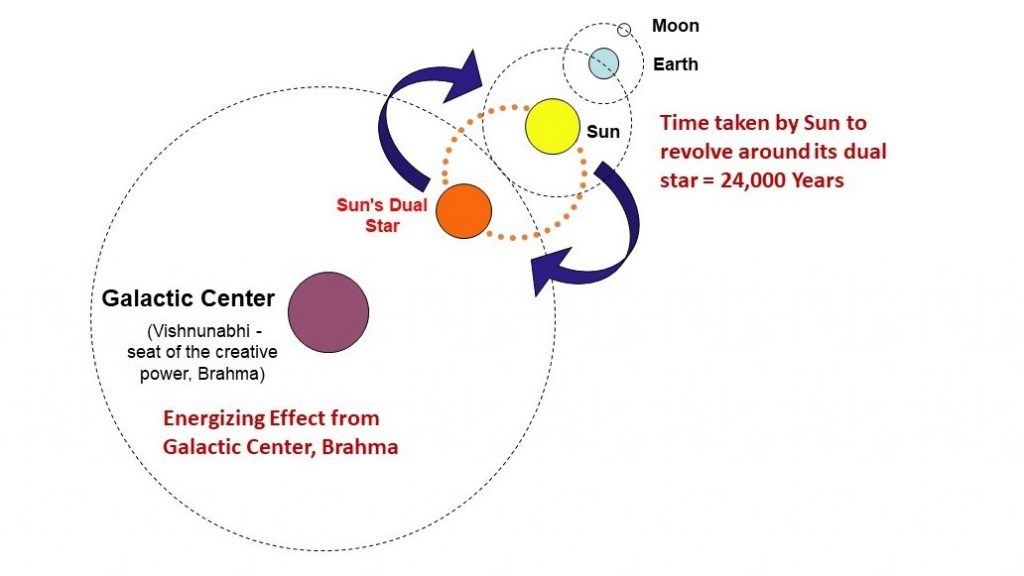
When the sun in its revolution round its dual comes to the place nearest to this grand centre, the seat of Brahma (an event which takes place when the autumnal equinox comes to the first point of Aries), dharma, the mental virtue, becomes so much developed that man can easily comprehend all, even the mysteries of Spirit.
The autumnal equinox will be falling, at the beginning of the twentieth century, among the fixed stars of the Virgo constellation, and in the early part of the ascending Dwapara Yuga.
After 12000 years, when the sun goes to the place in its orbit which is farthest from Brahma, the grand centre (an event which takes place when the autumnal equinox is on the first point of Libra), dharma, the mental virtue, comes to such a reduced state that man cannot grasp anything beyond the gross material creation. Again, in the same manner, when the sun in its course of revolution, begins to advance toward the place nearest to the grand centre, dharma, the mental virtue, begins to develop; this growth is gradually completed in another 12000 years.
Each of these periods of 12000 years brings a complete change, both externally in the material world, and internally in the intellectual or electric world, and is called one of the Daiva Yugas or Electric Couple. Thus, in a period of 24000 years, the sun completes the revolution around its dual and finishes one electric cycle consisting of 12000 years in an ascending arc and 12000 years in a descending arc.
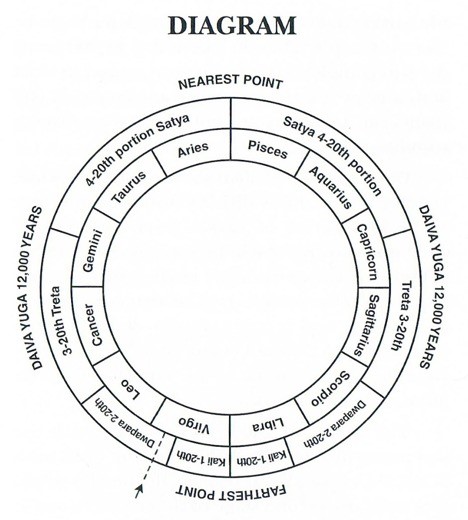
Development of dharma, the mental virtue, is but gradual and is divided into four different stages in a period of 12000 years. The time of 1200 years during which the sun passes through a 1/20th portion of its orbit (see Diagram) is called Kali Yuga. Dharma, the mental virtue, is then in its first stage and is only a quarter developed; the human intellect cannot comprehend anything beyond the gross material of this ever-changing creation, the external world.
The period of 2400 years during which the sun passes through the 2/20th portion of its orbit is called Dwapara Yuga. Dharma, the mental virtue, is then in the second stage of development and is but half complete ; the human intellect can then comprehend the fine matters or electricities and their attributes which are the creating principles of the external world.
The period of 3600 years during which the sun passes through the 3/20th part of its orbit is called Treta Yuga. Dharma, the mental virtue, is then in the third stage; the human intellect becomes able to comprehend the divine magnetism, the source of all electrical forces on which the creation depends for its existence.
The period of 4800 years during which the sun passes through the remaining 4/20th portion of its orbit is called Satya Yuga. Dharma, the mental virtue, is then in its fourth stage and completes its full development, the human intellect can comprehend all, even God the Spirit beyond this visible world.
Manu, a great rishi (illumined sage) of Satya Yuga, describes these Yugas more clearly in the following passage from the Samhita:
Four thousands of years, they say, is the Krita Yuga (Satya Yuga or the Golden Age of the world). Its morning twilight has just as many hundreds, and its period of evening dusk is of the same length (i.e. 400+4000+400=4800. In the other three ages, with their morning and evening twilights, the thousands and the hundreds decrease by one (i.e. 300+3000+300=3600, etc..). The fourfold cycle comprising 12000 years is called an Age of the Gods. The sum of a thousand divine ages constitutes one day of Brahma ; and of the same length is its night.
The period of Satya Yuga is 4000 years in duration; 400 years before and after Satya Yuga proper are its sandhis or periods of mutation with the preceding and the succeeding Yugas respectively; hence 4800 years in all is the proper age of Satya Yuga. In the calculation of the period of other Yugas and Yugasandhis, it is laid down that the numeral one should be deducted from the numbers of both thousands and hundreds which indicate the periods of the previous Yugas and sandhis. From this rule it appears that 300 years before and after are its sandhis, the periods of mutation, which make a total of 3600 years.
So, 2000 years is the age of Dwapara Yuga, with 200 years before and after as its sandhis; a total of 2400 years. Lastly, 1000 years is the length of Kali Yuga, with 100 years before and after as its sandhis; a total of 1200 years. Thus 12000 years, the sum-total of all periods of these four Yugas, is the length of one of the Daiva Yugas or Electric Couple, two of which, that is, 24000 years, make the electric cycle complete.
From 11,501 BC, when the Autumnal Equinox was on the first point of Aries, the sun began to move away from the point of its orbit nearest to the grand centre toward the point farthest from it, and accordingly the intellectual power of man began to diminish. During the 4800 years which the sun took to pass through one of the Satya Couples or 4/20th part of its orbit, the intellect of man lost altogether the power of grasping spiritual knowledge. During the 3600 years following which the sun took to pass through the Descending Treta Yuga, the intellect gradually lost all power of grasping the knowledge of divine magnetism. During the 2400 years following, while the sun passed through the Descending Dwapara Yuga, the human intellect lost its power of grasping the knowledge of electricities and their attributes. In 1200 more years the sun passed through the Descending Kali Yuga and reached the point in its orbit which is farthest from the grand centre; the Autumnal Equinox was on the first point of Libra. The intellectual power of man was so much diminished that it could no longer comprehend anything beyond the gross material of creation. The period around A.D. 500 was thus the darkest part of Kali Yuga and of the whole cycle of 24000 years. History indeed bears out the Indian rishis, and records the widespread ignorance and suffering in all nations at that period.
From A.D. 499 onward, the sun began to advance toward the grand centre, and the intellect of man started gradually to develop. During the 1100 years of the Ascending Kali Yuga, which brings us to A.D. 1599, the human intellect was so dense that it could not comprehend the electricities, Sukshmabhuta, the fine matters of creation. In the political world also, generally speaking, there was no peace in any kingdom.
Subsequent to this period, when the 100-year transitional sandhi of Kali Yuga set in, to effect a union with the following Dwapara Yuga, men began to notice the existence of fine matters, panchatanmatra or the attributes of electricities ; and political peace began to be established.
About A.D. 1600, William Gilbert discovered magnetic forces and observed the presence of electricity in all material substances.
In 1609 Kepler discovered important laws of astronomy, and Galileo produced telescope.
IN 1621 Drebbel of Holland invented the microscope.
About 1670 Newton discovered the law of gravitation.
In 1700 Thomas Savery made use of a steam engine in raising water.
Twenty years later Stephen Gray discovered the action of electricity on the human body.
In the political world, people began to have respect for themselves, and civilization advanced in many ways. England united with Scotland became a powerful kingdom. Napoleon Bonaparte introduced his new legal code into southern Europe. America won its independence, and many parts of Europe were peaceful.
With the advance of science, the world began to be covered with railways and telegraphic wires. By the help of steam engines, electric machines, and many other instruments, fine matters were brought into practical use, although their nature was not clearly understood. In 1899, on completion of the period of 200 years of Dwapara Sandhi, the time of mutation, the true Dwapara Yuga of 2000 years will commence and will give to mankind in general a thorough understanding of the electricities and their attributes.
Such is the great influence of Time which governs the universe. No man can overcome this influence except him who, blessed with pure love, the heavenly gift of nature, becomes divine; being baptized in the sacred stream Pranava (the holy Aum vibration), he comprehends the Kingdom of God.
The position of the world in the Dwapara Sandhi era at present (A.D. 1894) is not correctly shown in the Hindu almanacs. The astronomers and astrologers who calculate the almanacs have been guided by wrong annotations of certain Sanskrit scholars (such as Kulluka Bhatta) of the dark age of Kali Yuga, and now maintain that the length of Kali Yuga is 432,000 years, of which 4994 have (in A.D. 1894) passed away, leaving 427,006 years still remaining. A dark prospect! and fortunately one not true.
The mistake crept into almanacs for the first time during the reign of Raja Parikshit, just after the completion of the last Descending Dwapara Yuga. At that time Maharaj Yudhishthira, noticing the appearance of the dark Kali Yuga, made over his throne to his grandson, the said Raja Parikshit. Maharaja Yudhishthira, together with the wise men of his court, retired to the Himalaya Mountains, the paradise of the world. Thus, there was none in the court of Raja Parikshit who could understand the principle of correctly calculating the ages of the several Yugas.
Hence, after the completion of the 2400 years of the then current Dwapara Yuga, no one dared to make the introduction of the dark Kali Yuga more manifest by beginning to calculate from its first year and to put an end to the number of Dwapara years.
According to this wrong methods of calculation, therefore, the first year of Kali Yuga was numbered 2401 along with the age of Dwapara Yuga. In A.D. 499, when 1200 years, the length of the true Kali Yuga, was complete, and the sun had reached the point of its orbit farthest from the grand centre (when the Autumnal Equinox was on the first point of Libra in the heavens), the age of Kali in its darkest period was then numbered by 3600 years instead of by 1200.
With the commencement of the Ascending Kali Yuga, after A.D. 499, the sun began to advance in its orbit nearer to the grand centre, and accordingly the intellectual power of man started to develop. Therefore, the mistake in the almanacs began to be noticed by the wise men of the time, who found that calculations of the ancient rishis had fixed the period of one Kali Yuga at 1200 years only. But as the intellect of these wise men was not yet suitably developed, they could make out only the mistake itself, and not the reason for it. By way of reconciliation, they fancied that 1200 years, the real age of Kali, were not the ordinary years of our earth, but were so many daiva years (years of the gods), consisting of 12 daiva months of 30 daiva days each, with each daiva day being equal to one ordinary solar year of our earth. Hence according to these men, 1200 years of Kali Yuga must be equal to 432,000 years of our earth.
In coming to a right conclusion, however, we should take into consideration the position of the Vernal Equinox at spring in the year 1894.
The astronomical reference books show the Vernal Equinox now to be 20°54’36” distant from the first point of Aries (the fixed star Revati), and by calculation it will appear that 1394 years have passed since the time when the Vernal Equinox began to recede from the first point of Aries.
Deducting 1200 years (the length of the last Ascending Kali Yuga) from 1394 years, we get 194 to indicate the present year to the world’s entrance into the Ascending Dwapara Yuga. The mistake of older almanacs will thus be clearly explained when we add 3600 years to this period of 1394 years and get 4994 years, which according to the prevailing mistaken theory represents the present year (A.D.1894) in the Hindu almanacs.
In the book – ‘The Holy Science’ – certain truths such as those about the properties of magnetism, its auras, different sorts of electricities, etc., have been mentioned, although modern science has not yet fully discovered them. The five sorts of electricity can be easily understood if one will direct his attention to the nerve properties, which are purely electrical in nature. Each of the five sensory nerves has its characteristic and unique function to perform. The optic nerve carries light and does not perform the functions of the auditory and other nerves; the auditory nerve in its turn carries sound only, without performing the functions of any other nerves, and so on. Thus, it is clear that there are five sorts of electricity, corresponding to the five properties of cosmic electricity.
So far as magnetic properties are concerned, the grasping power of the human intellect is at present so limited that it would be quite useless to attempt to make the matter understood by the general public. The intellect of man in Treta Yuga will comprehend the attributes of divine magnetism (the next Treta Yuga will start in A.D. 4099). There are indeed exceptional personages now living who, having overcome the influence of Time, can grasp today what ordinary people cannot grasp; but this book is not for those exalted ones, who require nothing of it.
In concluding this introduction, we may observe that the different planets, exercising their influence over the various days of the week, have lent their names to their respective days; similarly, the different constellations of stars, having influence over various months, have lent their names to the Hindu months. Each of the great Yugas has much influence over the period of time covered by it; hence, in designating the years it is desirable that such terms should indicate to which Yuga they belong.
As the Yugas are calculated from the position of the equinox, the method of numbering the years in reference to their respective Yuga is based on a scientific principle; its use will obviate much inconvenience which has arisen in the past owing to association of the various eras with persons of eminence rather than with celestial phenomena of the fixed stars. We therefore propose to name and number the year in which this introduction has been written as 194 Dwapara, instead of A.D. 1894, to show the exact time of the Yuga now passing. This method of calculation was prevalent in India till the reign of Raja Vikramaditya, when the Samwat era was introduced. As the Yuga method of calculation recommends itself to reason, we follow it, and recommend that it be followed by the public in general.
Now, in this 194th year of Dwapara Yuga, the dark age of Kali having long since passed the world is reaching out for spiritual knowledge, and men require loving help one from the other. The publishing of this book, requested from me by my holy Paramguru Maharaj Babaji, will, I hope, be of spiritual service.
Swami Sri Yukteswar Giri
Serampore, West Bengal
The 26th Falgun, 194 Dwapara
(A.D. 1894)