
Upaveda (उपवेद)

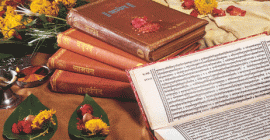

Upaveda (उपवेद)
The term Upaveda means ‘secondary knowledge’, a class of writings subordinate to the Vedas. They elucidate the specialized knowledge of the Vedas for practical applications and hence they are also referred to as texts of applied knowledge. There are four Upavedas. Each Upaveda is associated with one or the other Veda, which is the source of knowledge for that Upaveda. Thus, Āyurveda (आयुर्वेद) or science of medicine is attached to Ṛgveda (ऋग्वेद). According to some scholars such as Suśruta (सुश्रुत) it is a part of Atharvaveda (अथर्ववेद). Dhanurveda (धनुर्वेद) or military science to Yajurveda (यजुर्वेद); Gāndharvaveda (गान्धर्ववेद) or science of music to Sāmaveda (सामवेद) and Arthavidyā (अर्थविद्या) or Arthaveda (अर्थवेद) or science of polity and governance to Atharvaveda.
Āyurveda
Āyurveda is an ancient science of health and medicine. It comprises of holistic healthcare, diagnostic, and therapeutic practices. The origin of basic principles of Āyurveda are inherent in Ṛgveda and Atharvaveda and also in the texts of Purāṇas (पुराण) and Itihāsa (इतिहास) literature.
According to tradition, the original Āyurveda came from Brahmā (ब्रह्मा), who taught it to Aśvinī Kumara (अश्विनी कुमर) – the physicians of the Deva (देव), who through Indra (इन्द्र) transmitted it to the Ṛṣis (ऋषि) Bharadvāja (भरद्वाज), Punarvasu (पुनर्वसु), Atreya (अत्रेय), and Agniveśa (अग्निवेश). In due course of time, this original but sporadically scattered knowledge was collated, compiled, and organized systematically by Ṛṣis Caraka (चरक) and Suśruta and further explained by Vāgbhaṭa (वाग्भट).
Āyurveda, the tradition of a systematic health-science, is perhaps more than five thousand years old. The basic principles of Āyurveda are:
- that human body is composed of seven key constituents which are different forms of body tissues called Saptadhātu (सप्तधातु). Everything in nature including our body is made up of five elements Pañcamahābhuta (पञ्चमहाभुत) and
- that specific balance of three elemental energies or humours: Kapha (कफ) (water and the earth – “phlegm”), Pitta (पित्त) (fire and water – “bile”) and Vāta (वात) (air and space – “wind”) keeps the human body healthy. These humours are called dosha (दोश) in Sanskrit. When one or more of the humours go out of balance, the body loses its equilibrium and becomes unhealthy.
According to belief in tradition, around 700 BCE Sage Bharadvāja brought together the Ayurvedic system as a health science. Around 600 BCE Āchārya (आचार्य) Caraka, who is also known as the father of Indian medical science and pharmacology, wrote a comprehensive treatise ‘Caraka Saṁhitā’ (चरकसंहिता) on the Ayurvedic system as a health science. It is considered as a gospel of Ayurvedic medical system.
In the great tradition of Ayurvedic medicine, one cannot ignore two great schools of physicians – Suśruta (~400 BCE) and Kaśyapa (कश्यप) (~200 BCE). Suśruta wrote a treatise called ‘Suśruta Saṁhitā’ (सुश्रुतसंहिता). This book contains exhaustive information about surgery and lists around two thousand types of various surgeries and around hundred and twenty-five surgical apparatuses and tools. Suśruta is known as the first plastic surgeon of the world. There are evidences to bear out that he had implanted an artificial nose by plastic surgery. He recommended eye-surgery as a sure remedy for treatment of cataract.
Around 6th century CE, two great physicians, Senior or Jyeṣṭha (ज्येष्ठ) Vāgbhaṭa and Junior or Kaniṣṭha (कनिष्ठ) Vāgbhaṭa brought the two Saṁhitās (Caraka and Suśruta) together. In the development of Ayurvedic medicine, Vāgbhaṭa’s treatise Aṣṭāṅgasaṅgraha (अष्टाङ्गसंग्रह) and Aṣṭāṅgahṛdayasaṃhitā (अष्टाङ्गहृदयसंहिता) are quite well known.
Approach of Āyurveda is to treat a human being as a whole within himself and the disease as a constituent of the environment. Hence, Āyurveda is essentially a holistic health science.
Dhanurveda
Dhanurveda is the science of defence of an individual nation, or group of nations, war strategies, and use of sophisticated artillery. It is associated with Yajurveda. Dhanurveda is attributed to Ṛṣi Vishvamitra (विश्वमित्र). The word Dhanur (धनुर्) is not used here in the sense of bow alone but it also indicates all weapons that can be hurled at or struck upon the enemy such as discus, swords, spears, arrows, and other mysterious weapons like divyāstra (दिव्यास्त्र). Dhanurveda was considered an important science for building a common front against the external aggressors and protection of the kingdom. It was considered to be a complete science of warfare replete with the technology of its time.
Gāndharvaveda
Gāndharvaveda is the science of arts such as music, drama, dance, and painting. It is associated with Sāmaveda.
Vedic cosmogony highlights the fact that nāda (नाद) or śabda (शब्द) (meaning sound or tone) is the first manifestation from which the universe was created. In Gāndharvaveda music has been considered as a source to salvation. Tradition says that the knowledge of Gāndharvaveda was transmitted by Brahmā to Sarasvatī (सरस्वती), who in turn taught it to Nārada (नारद). Nārada passed this knowledge to Kaśyapa, who further imparted it to Bharata Muni (भरतमुनि). Bharata Muni (भरतमुनि) compiled this knowledge in Nāṭya śāstra (नाट्यशास्त्र), a text of about 36 thousand verses, which deals with – singing and instrumental music, i.e. gīta (गीत) or vādya (वाद्य), rhythm created by percussions and dance or nṛtya (नृत्य). Bharata Muni explains the origin of the seven notes – sā, re, ga, ma, pa, dha, ni (सा, रे, ग, म, प, ध, नि). All later aestheticians and scholars of poetics made Nāṭya śāstra as the very basis for writing their treatises.
Arthaveda or Arthavidyā
The description of subjects related with physical sciences, mathematics, geometry, architecture, politics, economics, in aphorisms format is associated with Atharvaveda. Artha (अर्थ) means substance. Arthavidyā or Arthaveda is the science of all which is ‘substance’ i.e. all knowledge related to practical life. By extension, this faculty of knowledge can include innumerable subjects, such as science, technology, polity, economics, etc. This Upaveda also includes the Nitī śāstra (नितीशास्त्र) (pedagogy, social ethics etc), the Śilpa śāstra (शिल्पशास्त्र) (handicrafts and architecture) and many other minor texts known as the 64 art forms or kalās (कला).
The word Artha literally means “something valuable” and includes everything that contributes to a high level of quality of life.