
Introduction

This is an endeavor to elucidate the esoteric concepts contained in the Indian and Western knowledge systems in a succinct comprehensible format and to present major milestones of human accomplishments that have created the present reality. This journey of more than thousands of years unravels the mysteries of man and universe, at both physical and metaphysical levels, through philosophy and science. This exploration may help bring fresh insights and better understanding of oneself and one’s reality.
The intent is to reach out to a much wider audience, who may not be aptly aware of the inbuilt significance and wealth of ancient wisdom. There is an overreaching need to revisit the ancient traditional thoughts and to try and synthesize them in the contemporary context.

INDIAN TRADITIONAL CONCEPTS
The Indian pursuit began by probing into the ways of liberating one-self from the material world. This quest began to seek reality and the purpose of human life on the background of the world. It first questioned who the knower is, how does he come to know and gain knowledge. This knowledge led to the understanding of reality. All the schools of philosophy or Darśana (दर्शन), Vedic or non-Vedic, evolved around seeking reality. In Indian philosophical thought process, reality has been perceived as dualism advancing ultimately towards non-dualism or monism. Therefore, in the east, the cognitive process which originated from self and streamed towards the world is termed as ‘trans-formation’, against ‘in-formation’ of science. The Indian pursuit being all-inclusive is essentially holistic; it streams from ‘whole to the parts’ or as the Vedanta contemplates, ‘from Ātman (आत्मन्) (self) to the multifarious objectivity’.
Veda (वेद) and Śāstra (शास्त्र)
The copious Indian literature contains scriptures and texts such as Veda (वेद), Upaniṣad (उपनिषद्), Saṁhitā (संहिता), Brāhmaṇa (ब्राह्मण), Āraṇyaka (आरण्यक), Itihāsa (इतिहास), Purāṇa (पुराण), Śāstra (शास्त्र), Smṛti (स्मृति) or Dharmaśāstra (धर्मशास्त्र), etc. These are classified in different ways by various Schools of Thought. Broadly, this vast literature can be classified under two segments – Vedas and Śāstras.
- Vedas assume a very prominent place in the Indian culture and ethos. The word Veda is a derivative of Sanskrit root of the verb vid (विद्) means ‘to know’. Thus, Veda means ‘knowledge’. The Vedic text is referred to as Śruti (श्रुति) – that which is heard or revealed.
- Śāstra means any discipline or faculty of knowledge, or any science. The word Śāstra also denotes religious or sacred treatise, sacred book or scripture of human origin and is also referred to as Smṛti (स्मृति).
Common perception is that what is Vedic language is also Sanskrit. However, it is important to understand that the language of Vedas and some Vedic treatises is Devabhāṣā (देवभाषा) or Vedic language and language of allied Vedic literature and Śāstras is primarily Sanskrit.
The diagram below depicts the two segments and their subsequent classifications and sub-classifications.
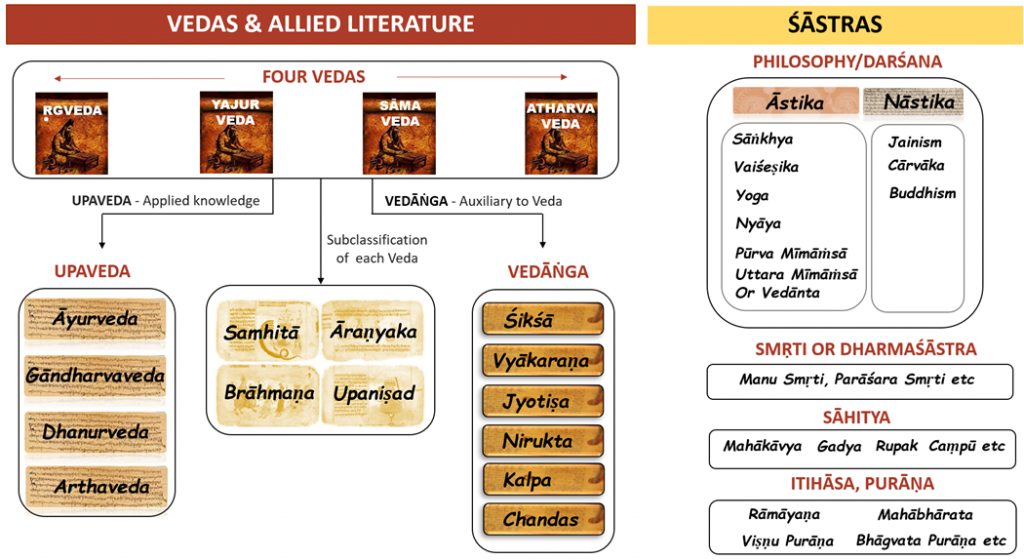
The Vedas and Allied Literature include
Veda (वेद), Upaveda (उपवेद) and Vedāṅga (वेदांग)
Veda (वेद)
The four Vedas (also known as Śruti (श्रुति)) are:
- Ṛgveda (ऋग्वेद)
- Sāmaveda (सामवेद)
- Yajurveda (यजुर्वेद)
- Atharvaveda (अथर्ववेद)
Each of these Vedas has its own segments of:
- Saṁhitā (संहिता)
- Brāhmaṇa (ब्राह्मण)
- Āraṇyaka (आरण्यक)
- Upaniṣad (उपनिषद्)
Upaveda (उपवेद)
Upaveda (उपवेद) denotes investigating or enquiring into knowledge. By extension it could also mean ‘applied knowledge’. There are four Upavedas, each having its origin in either of the four Vedas:
- Āyurveda (आयुर्वेद)
- Dhanurveda (धनुर्वेद)
- Gāndharvaveda (गान्धर्ववेद)
- Arthavidyā (अर्थविद्या) or Arthaveda (अर्थवेद)
Vedāṅga (वेदांग)
In due course of time, owing to some ostensible reasons, the language of Vedas did not develop further. Consequently, it became archaic and difficult for people to understand. In the wake of this reality, an auxiliary text emerged in the form of Vedāṅga (वेदांग). There are six Vedāṅgas :
- Śikśā (शिक्षा)
- Vyākaraṇa (व्याकरण)
- Jyotiṣa (ज्योतिष)
- Nirukta (निरुक्त)
- Kalpa (कल्प)
- Chandas (छन्दस्)
The Śāstra literature includes
Philosophy or Darśana (दर्शन), Smṛti (स्मृति) or Dharmaśāstra (धर्मशास्त्र), Sanskrit Sāhitya (संस्कृत साहित्य), Itihāsa (इतिहास), Purāṇa (पुराण)
Philosophy or Darśana
Based on allegiance or non-allegiance to Vedas, two schools of Philosophy or Darśana (दर्शन) developed
- Āstika Darśana (आस्तिक दर्शन)- having allegiance to Vedas.
In the Āstika Darśana category there are six schools of philosophy – Sāṅkhya (सांख्य), Vaiśeṣika (वैशेषिक), Yoga (योग), Nyāya (न्याय), Pūrva Mīmāṁsā (पूर्व मीमांसा) and Uttara Mīmāṁsā (उत्तर मीमांसा) or Vedānta (वेदांत). - Nāstika Darśana (नास्तिक दर्शन) – having no allegiance to Vedas.
In the Nāstika Darśana category there are three main schools of philosophy: Jainism, Cārvāka (चार्वाक) and Buddhism.
Here, it would be proper to mention that irrespective of allegiance or no allegiance, Vedas do continue to remain fundamental for both the categories of schools of philosophy.
Smṛti (स्मृति) or Dharmaśāstra (धर्मशास्त्र)
Smṛti (स्मृति) or Dharmaśāstra (धर्मशास्त्र) is a genre of Sanskrit theological texts which refer to the treatises dealing with human conduct vis-à-vis, family, society and country. It includes the body of traditional, civil, or religious code of laws. E.g. Manusmṛti (मनुस्मृति), Parāśarasmṛti (पराशरस्मृति), Yājñavalkyasmṛti (याज्ञवल्क्यस्मृति).
Sanskrit Sāhitya (संस्कृत साहित्य) or Sanskrit literature
Sanskrit Sāhitya (संस्कृत साहित्य) can be broadly categorized as Mahākāvya (महाकाव्य) or epic poetry, Rūpaka (रुपक) or plays, Gadya kāvya (गद्य काव्य) or prose literature, Khaṇdakāvya (खण्डकाव्य) or small poems, and Caṃpū (चंपू) Literature.
Itihāsa (इतिहास) – Purāṇa (पुराण)
The word Purāṇa means “ancient or old”; Purāṇas are considered to be a tale of the past legends, ancient or legendary history (Itihāsa) and genealogy of dynasties. Eg Rāmāyaṇa (रामायण), Mahābharata (महाभारत), Bhāgvata Purāṇa (भागवत पुराण), Viṣṇu Purāṇa (विष्णुपुराण) etc.
The details of each of these topics have been further elaborated in the website.
WESTERN TRADITIONAL CONCEPTS
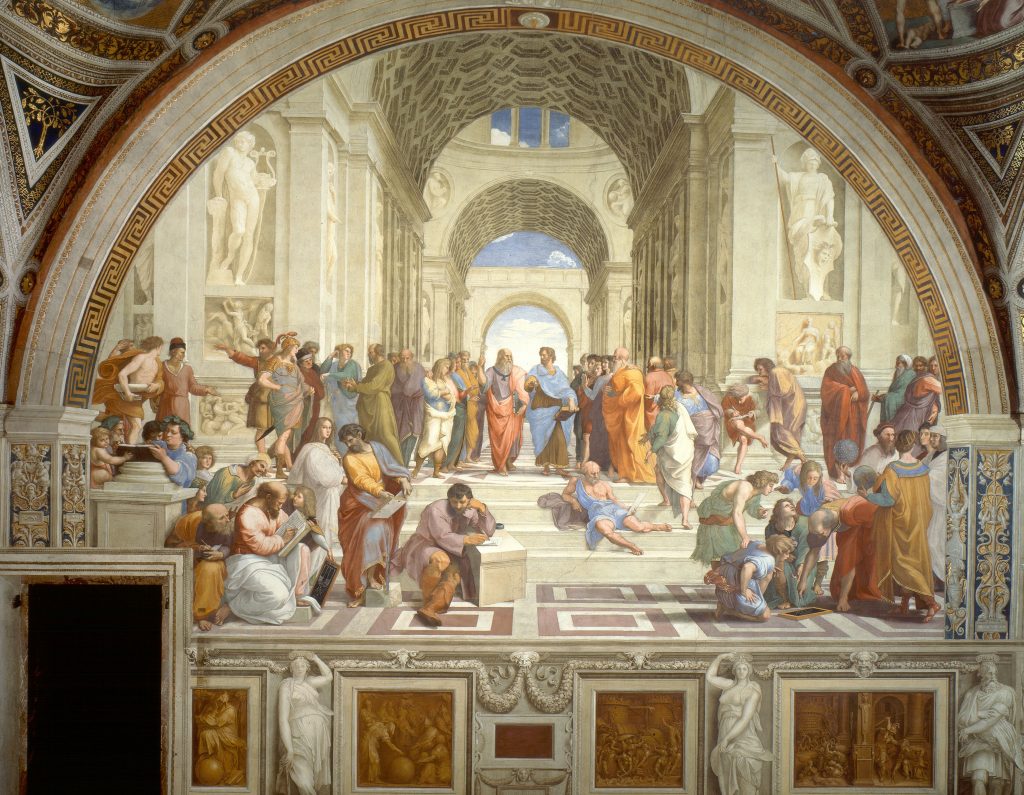
The Western philosophy finds its birth in the Greek philosophy of 6th century BCE. It began with the exploration of the fundamental nature of matter with an endeavor to find a unified principle from which the diversity in the world came forth. Philosophy evolved with social necessity of times. With changing socio- economic and political conditions and the rise of religions, like Christianity and Islam, medieval thought was influenced by dogma and theology. Till as late as 17th century CE there was no distinction between science and philosophy in the West. The advancement of scientific thought and industrial revolution separated science from both philosophy and religion. Science was thereafter dedicated solely to study of objective reality and philosophy to the synthesizing of human experiences. In its very basic premise, western philosophy focuses on parts of an idea and finding the differences in ideas. There is a reductionist approach wherein ideas are broken down to fragments with use of logic, deductive reasoning and categorization with an emphasis on important aspects of an issue rather than a holistic view. Thus, the Western pursuit in every field starts from multiplicity and flows to unity or follows the path of ‘parts to whole’.
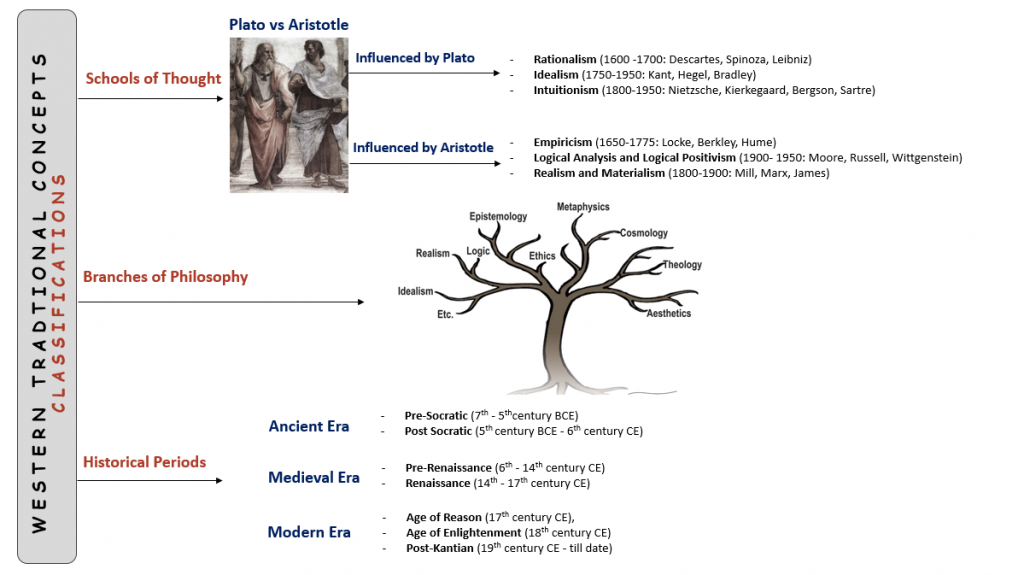
The Western Philosophy can be organized in following ways –
- Schools of thought
- Branches of Philosophy
- Historical Periods
Schools of thought
Based on the schools of thought, the Western philosophical thoughts can be broadly classified as:
- the idealist approach of Plato (429-347 BCE) and
- the realist approach of Aristotle (384-322 BCE).
Platonic idealist approach: Idealism is a philosophical doctrine which believes reality to be beyond physical perception and that the meaning and truth of things lie in the idea or purpose that the mind discovers in them.
The schools influenced by Platonic thought include
- Rationalism (1600 -1700: Descartes, Spinoza, Leibniz)
- Idealism (1750-1950: Kant, Hegel, Bradley)
- Intuitionism (1800-1950: Nietzsche, Kierkegaard, Bergson, Sartre).
Aristotelian realist approach: Realism is a scholastic doctrine which believes in material reality and states that universal or general ideas have objective existence.
The schools influenced by Aristotelian thought include
- Empiricism (1650-1775: Locke, Berkley, Hume)
- Logical Analysis and Logical Positivism (1900- 1950: Moore, Russell, Wittgenstein)
- Realism and Materialism (1800-1900: Mill, Marx, James).
Branches of Philosophy
Based on the branches of philosophy, the Western philosophy can be divided into six main branches.
- Epistemology – deals with issues about knowledge and justification of belief.
- Metaphysics – seeks to address issues of existence and nature of reality.
- Ethics – asks what is right and wrong, how should we live, what we should do.
- Logic – focuses on correct reasoning, investigation and critical analysis.
- Political philosophy – addresses issues concerning governance, laws and power.
- Aesthetics – engages in the nature and interpretation of beauty and taste.
Historical periods
Based on time periods, Western Philosophy can be broadly classified into three main eras.
Ancient Era is divided into
- Pre-Socratic (7th – 5th century BCE)
- Post Socratic (5th century BCE – 6th century CE)
Medieval Era is divided into
- Pre-Renaissance (6th – 14th century CE)
- Renaissance (14th – 17th century CE)
Modern Era is divided into
- Age of Reason (17th century CE),
- Age of Enlightenment (18th century CE)
- Post-Kantian (19th century CE – till date)
SCIENCE & TECHNOLOGY

Ancient Indian texts such as the Vedas, Vedāṅgas, Upaniṣads, Darśanas contain holistic approach towards knowledge encompassing all aspects of life – the physical as well as the spiritual, mundane as well as transcendental. In India and the West, numerous intensive and exhaustive studies have been done on these texts with regards to metaphysical and spiritual knowledge. However, a glaring vacuum of adequate research and study of the Indian scientific texts is observed when it comes to subjects like astronomy, physics, chemistry, medicine, etc.
In his pursuit for unraveling the mysteries of Nature, man faced many challenges. In the preliminary stages, owing to lack of appropriate equipment and devices, the progress of this exploration was very limited. Nature is the largest and the most extensive laboratory known to man. However, well-equipped laboratories were necessary to test hypotheses, particularly related to science and technology, and convert them into proved doctrines or principles. To overcome this predicament, ingenious Indian scholars of ancient times conceptualized Pramāṇa (प्रमाण) – ways of testimony, modes of proof or means of arriving at correct knowledge. These were:
- Direct sensory perception or Pratyakṣa Pramāṇa (प्रत्यक्ष प्रमाण),
- Reasoning and inference or Anumāna (अनुमान),
- Analogue or Upamāna (उपमान) and
- Authoritative expression or Āptavākya (आप्तवाक्य) or Śiṣṭavākya (शिष्टवाक्य).
With the help of these testimonies and modes of approach, the thinkers tried to fathom and prove the well-rooted secrets of Nature. Texts related to the ‘Sūtra (सूत्र) Period’ (800 BCE to 100 CE), show that the ancient Indian people had knowledge of principles of Physics, Chemistry, Metallurgy, as well as the knowledge of conducting experiments required to establish these principles. Subsequently, Sāṅkhya (सांख्य) and the Vaiśeṣika (वैशेषिक) schools fostered and developed this scientific spirit with their emphasis on direct observation, exact measurement, logical reasoning, and persistent enquiry. While Sūtra period (800 BCE to 100 CE (by extension)) was the acme of scientific and technological pursuit, the subsequent time-span of ~1200 years saw the peak of knowledge in the fields of Mathematics, Astronomy, Jyotiṣa (ज्योतिष), Astrophysics and other branches of Science. This period is known for contributions by Lagadha (लगध), Āryabhaṭṭa (आर्यभट्ट), Brahmagupta (ब्रह्मगुप्त), Bhāskara I (भास्कर १), Bhāskara II (भास्कर २) etc.
Thus, it is obvious that the scientific thought in ancient India was not only existent, but had already developed, centuries before the European Renaissance.
The need of the hour is a symbiotic approach wherein the thoughts and principles from both the streams – Modern Science and Ancient Indian Science be integrated so that a holistic and complete material science emerges.
In this website we will briefly present the knowledge related to Science and Technology contained in the ancient Indian texts.