
Vedas and Allied Literature

Vedas and Allied Literature
Vedas have been adjudged as one of the oldest texts in the world literature. The language of Vedas and other Vedic scriptures is traditionally considered to be Devabhāṣā (देवभाषा) or Vedic language and language of later Vedic treatises and Śāstras (शास्त्र) is primarily Sanskrit. People at large are hardly aware that Vedic and Sanskrit are similar but two different languages.
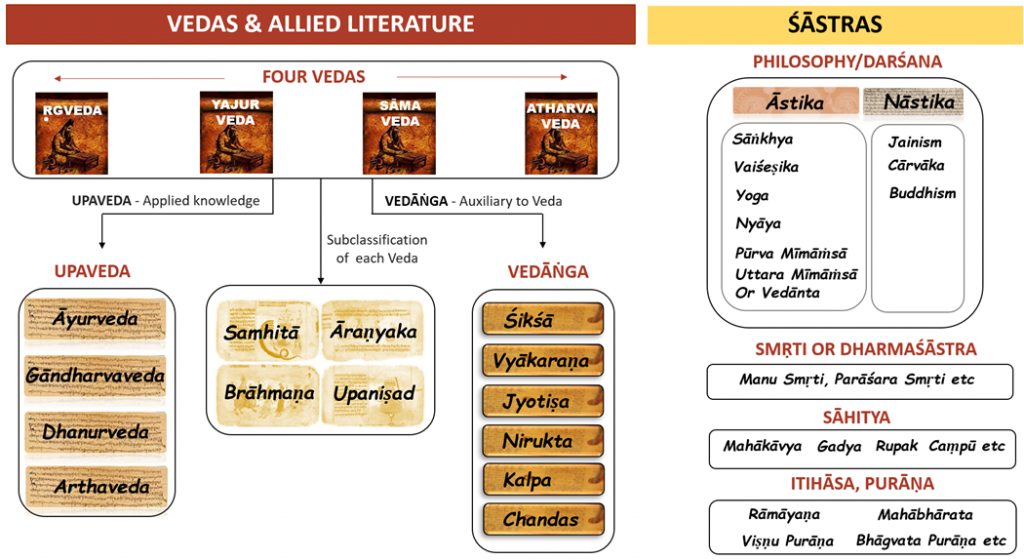
The Vedas and allied literature include
Veda (वेद), Upaveda (उपवेद) and Vedāṅga (वेदांग)
Veda (वेद)
Vedas assume a very prominent place in the cultural ethos of India. The word Veda is a derivative of Sanskrit root of the verb vid (विद्) means ‘to know’. The Vedic text is referred to as Śruti (श्रुति) – that which is heard or revealed and is not of human creation (Apauruṣeya (अपौरुषेय)), but of Divine origin. Vedas were studied, learnt and recited by a selected class of people and were passed on from generation to generation by oral tradition, till they were documented centuries later.
The four Vedas are: Ṛgveda, (ऋग्वेद), Sāmaveda (सामवेद), Yajurveda (यजुर्वेद) and Atharvaveda (अथर्ववेद). Each of these Veda has its own segments of Saṁhitā (संहिता), Brāhmaṇa (ब्राह्मण), Āraṇyaka (आरण्यक) and Upaniṣad (उपनिषद्)
Upaveda (उपवेद)
Upaveda (उपवेद) is subsidiary to the Veda. It denotes investigating or enquiring into the knowledge contained in the Vedic scriptures. Each Upaveda is associated with one or the other Veda, which is the source of knowledge for that Upaveda. There are four Upavedas – Āyurveda (आयुर्वेद) or science of medicine, Dhanurveda (धनुर्वेद) a military science, Gāndharvaveda (गान्धर्ववेद) or science of music, Arthavidyā (अर्थविद्या) or Arthaveda (अर्थवेद) or the science of governance and finance.
Vedāṅga (वेदांग)
In due course of time, owing to some ostensible reasons, the language of Vedas did not develop further. Consequently, it became archaic and difficult for people to understand. In the wake of this reality, an auxiliary text emerged in the form of Vedāṅga (वेदांग). Vedāṅgas are designated to aid in the correct pronunciation and interpretation of the Vedic texts and the right employment of the Vedic mantras in ceremonies.
There are six Vedāṅgas: Śikśā (शिक्षा), Kalpa (कल्प), Vyākaraṇa (व्याकरण), Nirukta (निरुक्त), Chandas (छन्दस्) and Jyotiṣa (ज्योतिष).