
Science & Technology Journey

journey of Science & Technology
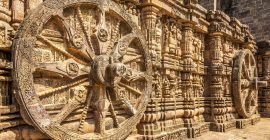
Science in Ancient India
It has been well established that people of ancient India had a very good knowledge of various subjects related to science. There are documentary proofs available which bear out that science was the underlying thought of ancient Vedic literature. Several scientific concepts, including cosmology and cosmogony, Big Bang theory, etc. find discussion in the Upanishadic literature and subsequent Sūtra treatises. Many manuscripts related to the ‘Sūtra Period’ (800 BCE – 100 CE) have been discovered which clearly show that ancient Indian people had the knowledge of various concepts and principles related to astrophysics, chemistry, physics and metallurgy, etc.
However, after the 5th century CE, interest in Science among the general masses started waning. Post Bhāskarācārya II (भास्कराचार्य) (~1200 CE), the situation worsened. There was general apathy among Indian scholars in reorganizing and reconstructing the traditional knowledge base and they became indifferent towards further development of this knowledge base. The reasons for this could be:
- Due to widespread impact of Buddhism, the practice of Vedic tradition started ebbing and propagation of Vedic knowledge declined.
- The Vedic scholars realized that there was an urgent need to re-establish Vedic ethos and they wholeheartedly embarked upon the resurgence of Vedic, primarily through metaphysical interpretation.
- The strengthening of the structure of caste system, particularly in the post Ādi Śaṅkarācārya (आदि शङ्कराचार्य) era (~ 800 CE), arrested dissemination of kno wledge to the general population. Inaccessibility of the original texts to common people owing to complexity of language and social-religious restrictions led to dilution of scientific thinking. Thereafter, only a handful schools of thought, both Vedic and Buddhist, continued the scientific tradition in the fields of mathematics, astronomy, and medicine.
- There was extensive loss and damage of source material such as manuscripts, books, documents, etc. because of frequent foreign invasions. It is a well-known fact that invaders burnt and destroyed the famous centres of learning such as Nālandā (नालंदा), Takṣaśilā (तक्षशिला), Vikramaśilā (विक्रमशीला), etc. where manuscripts and books were stored.
All these factors led to an atmosphere and ambiance unfavourable to learning and development of knowledge.
Below is the chronology of the development of various sciences in Indian knowledge systems:
- In the year 1350 BCE, world’s first astronomer Lagadha (लगध) prepared five yearly almanac Pañcāṅgam (पञ्चाङ्गम्) in his astronomical treatise Vedāṅga Jyotiṣa (वेदांग ज्योतिष).
- Śulbasūtras (शुल्बसूत्र) were composed between 800 BCE – 400 BCE. Śulbasūtra means measurement tape. The composers of the four known Śulbasūtras, are Baudhāyana (बौधायन), Āpastamba (आपस्तम्ब), Mānava (मानव) and Kātyāyana ((कात्यायन) supposedly, contemporary of Pythagoras). Baudhāyana (~800 BCE), a mathematician, in his treatise Baudhāyana Śulbasūtra mentioned Pythagorean Theorem, 250 years ahead of Pythagoras.
- Aṁśubodhinī (अंशुबोधिनी) is one of the works of the Sūtra period (800 BCE – 100 CE) on Cosmology and Physics of Nuclear Particles. These Sūtras were created by Maharṣi Bharadvāja (महर्षि भरद्वाज) and an interpretation on these Sūtras was written by the commentator Bodhānanda (बोधानन्द). The treatise of Maharṣi Bharadvāja covered some fundamental concepts about cosmology, aeronautics, and particle physics, besides elaborate discussion on making of several tools, gadgets and apparatus, and alloys.
- Maharṣi Kaṇāda (महर्षि कणाद) (~600 BCE) was the author of Vaiśeṣika Darśana (वैशेषिक दर्शन) which discusses atomic principle and other concepts of physics, and also cognitive sciences.
- Āyurveda (आयुर्वेद) is the most ancient holistic healthcare, diagnostic and therapeutic science of the world. The main principle of natural balance of the three body humours – Kapha (कफ), Pitta (पित्त), and Vāta (वात) was first formally firmed up by sages Bharadvāja and Agastya (अगस्त्य) (700 BCE).
- Ācārya Caraka (आचार्य चरक) wrote Carakasaṁhitā (चरकसंहिता) (~600 BCE). He is considered as the father of Indian medical science and pharmacology.
- World’s first general plastic surgeon Suśruta (सुश्रुत) (~400 BCE) wrote Suśrutasaṁhitā (सुश्रुतसंहिता).
- The pioneer of Mahāyāna (महायान) sect, Buddhist philosopher, and world’s first alchemist Nāgārjuna (नागार्जुन) (150 CE-250 CE) introduced medicinal use of metal oxides known as Siddhā (सिद्धा) medicinal system.
- Āryabhaṭṭa I (आर्यभट्ट १) (476 CE – 550 CE) was a leading mathematician-astronomer from the classical age of Indian mathematics and Indian astronomy. He gave the value of pi correct up to four decimals.
- Varāhamihira (वराहमिहिर) (505 CE – 587 CE) was one of the famous astronomers and astrologers of ancient India. His book Pañcasiddhāntikā (पंचसिद्धांतिका) discusses five astronomical canons called Sūrya (सूर्य), Romak (Rome), Paulisa (Greek), Vaśiṣṭha (वशिष्ठ) and Paitāmaha (पैतामह). Varāhamihira’s other well-known book is Bṛhātsaṁhitā (बृहत्संहिता) which deals with astrology.
- Brahmagupta (ब्रह्मगुप्त) (598 CE – 668 CE) was a famous mathematician and astronomer. He was the head of the observatory at Ujjain. He wrote four treatises, amongst them the treatise titled Brahmasphuṭasiddhāṅtaḥ (ब्रह्मस्फुटसिद्धांतः) is quite famous.
- Bhāskara I (भास्कर १) (600 CE – 680 CE) was a mathematician who wrote Mahābhāskarīya (महाभास्करीय).
- Bhāskarācārya II (भास्कराचार्य २) (1114 CE – 1185 CE) was a mathematician. He has been designated the greatest mathematician of medieval India. His main work Siddhāntaśiromaṇi (सिद्धांतशिरोमणि) is divided into four parts: Līlāvatī (लीलावती), Bījagaṇita (बीजगणित), Grahagaṇita (ग्रहगणित) and Golādhyāya (गोलाध्याय), which are also sometimes considered as four independent works. His treatises deal with Arithmetic, Algebra, Geometry, Trigonometry and Astronomy. Arabs translated these treatises and passed on to the west.
It cannot be denied that till recent times, Indian scholars had no idea of the treasure of scientific and technological knowledge inherently imbedded in the ancient Indian scriptures. In recent times it was Swāmī Dayānanda Saraswatī (स्वामी दयानंद सरस्वती) (1824 CE-1883 CE) who advocated scientific studies of Vedic literature. Swāmī Vivekānanda (विवेकानंद) (1863 CE -1895 CE) was another powerful and eminent philosopher who attempted unification of science and Vedanta. It is a known incident that after listening to Swāmī Vivekānanda’s speech the famous scientist Nicola Tesla (1856-1953) was inspired to prove scientifically that the two distinct physical quantities matter and energy are ultimately one. It is only in the last 30 years that scholars have become aware of the riches of ancient Indian scientific knowledge and a good deal of research is being conducted in this field, all over the country. Contemporary scientists like late Dr. Narayan Gopal Dongre (1939 – 2009) and others have contributed immensely to the task of revealing the ancient Indian scientific and technological knowledge. In the conceptual field eminent names are Dr. Vijay Bhatkar, Shashikant Shukla and Dr. C. S. Prabhu. Contributions of these scholars is in the form of writing and editing books in the field of comparative and symbiotic analysis between science and philosophy.
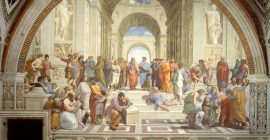
Science in the West
The early Greeks did not organize the various subjects or disciplines as we know them today – science, medicine, ethics, social science, philosophy, logic, psychology. They were speculators of the workings of Nature. From Pythagoras to Ptolemy, the ancient Greek philosophers looked for a unifying principle beneath the diversity in the natural world, through developing scientific concepts in mathematics, cosmology, atomism, matter, motion, space and time. Early in the West, before renaissance and until 15th century, philosophers clubbed science with philosophy together and called it ‘natural philosophy’. For about 1300 years after Ptolemy (~170 CE) there was apparent stagnation in scientific thought, due to predominance of religious dogma. In the 15th century Copernicus challenged the Christian faith that earth stands still at the center of the universe. A century later Galileo laid foundation of natural sciences. Science was thereafter dedicated solely to the study of objective reality.
Below is the chronology of the development of various sciences in Western world :
- Pythagoras (~582 BCE – 500 BCE) – was an ancient Greek Philosopher and mathematician who was credited with many mathematical and scientific discoveries, including the Pythagorean theorem.
- Empedocles (~484 BCE -424 BCE) proposed that matter in the world has four constituting elements: earth, fire, water, and air.
- Leucippus (~ 440 BCE) and Democritus (~460 BCE -370 BCE) proposed that matter is constituted of indivisible atoms. Their hypothesis stated that atoms of the fundamental elements differ from each other in weight; but they were identical for the same element.
- Hippocrates (~460 BCE-380 BCE) was considered as the Father of Medicine.
- Aristotle (384 BCE-322 BCE) – the intellectual range of this outstanding Greek philosopher and scientist was so wide that it covered almost all branches of science including physics, biology, zoology, botany, chemistry, many of the arts, history, logic, metaphysics, rhetoric, philosophy of mind, philosophy of science, poetics, political theory, psychology; in addition, political theory and ethics.
- Euclid (~325 BCE – 265 BCE) was the famous Greek mathematician, considered as the Father of Geometry.
- Archimedes (287 BCE-212 BCE) was a famous Greek mathematician, physicist, engineer, inventor, and astronomer. He devised methods for computing volumes and areas of complex geometrical shapes; introduced the theory of statics and devised a system for expressing exponential numbers.
- Ptolemy (~90 CE -168 CE) conceived of physical entities matter, space, time, motion, and the ideas in cosmology based on Aristotelian concepts. He proposed geocentric cosmology.
- Copernicus (1473 CE – 1543 CE) presented the heliocentric cosmological model and challenged the Christian faith that earth stands still at the centre of the universe.
- Galileo (1564 CE -1642 CE) – known as the Father of Modern Science, was an Italian polymath: astronomer, physicist, engineer, and mathematician.
- Kepler (1571 CE – 1630 CE) – was a German mathematician and astronomer. He is best known for his laws of planetary motion.
- Descartes (1596 CE – 1650 CE) – was a French philosopher, mathematician, physicist. He sowed the seeds of dualism of ‘mind and matter’ and freed the material world from spirituality.
- Isaac Newton (1642 CE – 1727 CE) – was a British physicist-mathematician. Besides laying the foundations of classical physics, his major contributions in physics include the discoveries of universal laws of motion and gravitation, optics including the theory of color, law of cooling, speed of sound, and confirmation of the heliocentric model of our planetary system. His significant contributions to mathematics include the invention of calculus among other things.
The commencement and development of Western Scientific thought process has all along been very well organized and systematically documented. The information regarding Western scientific and technological progress is easily accessible and widely available. In this website we will try and explore only the ancient Indian scientific thought process.