
Indian Wisdom Journey

JOURNEY OF INDIAN WISDOM
The determination of the periods of compositions of ancient Indian texts is an arduous task because the knowledge of some of these texts, particularly that of Vedic texts, was passed from generation to generation in the oral tradition and the documentation occurred much later. It is important to note that these texts were composed and propagated across multiple regions of India, over centuries, by various scholars and teachers. These ancient thinkers were not too concerned with their names being attached to doctrines, scriptures, or texts as prime originators or as propagators.
The determination of periodicity of Indian literature, including that of Veda (वेद), done till now was mainly supported by the Aryan Migration theory. According to some scholars, Aryans migrated to India around 1800 BCE to 1500 BCE and composed the Vedas, implying that original Indian inhabitants were not competent and diligent enough to create literature of such highest order. Prof. Max Muller had initially called Vedic literature as barbaric. However, after studying it in depth, he changed his statement and declared Vedānta (वेदांत), and Upaniṣad (उपनिषद्) as the “acme of human philosophical speculation”.
New evidences and recent findings in genetics of the indigenous population, studies on literature and linguistics, and fresh excavations at Rakhigarhi site (2018) in Haryana, set aside the theory of Aryan migration and invasion. This evidence indicates that Vedas were not composed by the so called Aryan immigrants but by the indigenous people of India, much before 1800 BCE. In the wake of certain facts, now western scholars also accept the period of the composition of Vedas as ~ 2500 BCE – 2000 BCE. These dates are however based on best approximations.
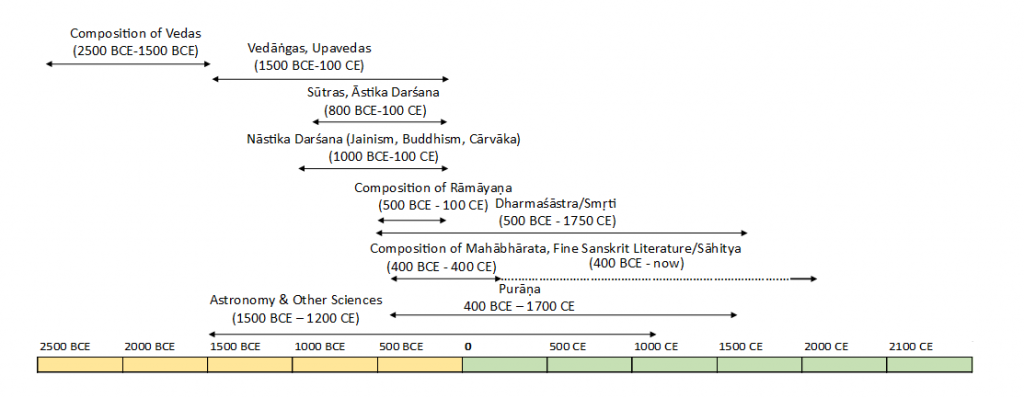
The diagram below depicts the journey of Indian knowledge system –
Vedic Scriptures (~2500 BCE – 1500 BCE)
Based on the premises put forward by various scholars and having taken into account the new evidences, the period of composition of Ṛgveda (ऋग्वेद) can be affirmed as ~2500 BCE. Other Vedas and their respective divisions (including Saṁhitā (संहिता), Brāhmaṇa (ब्राह्मण), Āraṇyaka (आरण्यक) and Upaniṣad (उपनिषद्)) might have been composed during the following 1000 years i.e until 1500 BCE.
Upaveda (उपवेद) (~1500 BCE – 100 CE)
The Upavedas (Āyurveda (आयुर्वेद), Gāndharvaveda (गान्धर्ववेद), Dhanurveda (धनुर्वेद), Arthavidyā (अर्थविद्या) or Arthaveda (अर्थवेद)) might have been written during 1500 BCE to 100 CE.
Vedāṅga (वेदांग) (~1500 BCE – 100 CE)
The composition of Vedāṅga (Śikśā (शिक्षा), Vyākarana (व्याकरण), Jyotiṣa (ज्योतिष), Nirukta (निरुक्त), Kalpa (कल्प), Chandas (छन्दस्)) might have begun immediately after ~1500 BCE and continued till the extended Sūtra (सूत्र) period, i.e. 800 BCE to 100 CE.
Schools of Philosophy/Darśana (दर्शन) (~1000 BCE – 100 CE)
There are two categories of philosophy – Āstika (आस्तिक) and Nāstika (नास्तिक).
- All the Sūtras of Āstika category of Darśanas (Sāṅkhya (सांख्य), Vaiśeṣika (वैशेषिक), Nyāya (न्याय), Yoga (योग), Vedānta (वेदांत) and Mīmāṁsā (मीमांसा)) were written during 600 BCE to 100 CE
- Nāstika Darśana consists of Jainism, Cārvāka (चार्वाक) or Lokāyata (लोकायत), and Buddhism. The timelines of each of these are described below –
- Jainism
The fundamental concepts of Jainism emerged with the teachings of Lord Ādinātha Ṛṣabhadeva (आदिनाथ ऋषभदेव), the first Tīrthaṅkara (तीर्थंकर) who might have existed about 4-5 centuries after the Vedic period (~1000 BCE). Tīrthaṅkaras are the canonical preceptors of Jainism. According to the Jain hierarchy there were twenty-four such sages who were called as Tīrthaṅkara. Pārśvanātha (पार्श्वनाथ) (872 BCE- 749 BCE) and Mahāvira (महावीर) (599 BCE – 527 BCE) were the last two Tīrthaṅkaras. - Cārvāka (चार्वाक)
There is no ground on which Cārvāka’s timeline can be determined. Traditionally it is conjectured that he wrote Sūtras. This is the only remote speculation based on which Cārvāka’s period can be assumed to be Sūtra period. His Sūtras however, became extinct immediately after they were written. It is said that the doctrines of Cārvāka were considered derogatory and in due course of time became another expression for atheism. It was only during 6th to 8th century CE that the concepts of Cārvākism emerged afresh and the term Cārvākism began to be used to denote materialist thought in the Indian context and was known as Lokāyata (लोकायत). - Buddhism
Lord Gautama Buddha (गौतम बुद्ध) (563 BCE – 483 BCE), was Mahāvira’s contemporary. It is important to take note of the fact that the formal launch of Buddhism was not done by Buddha. Buddhism, as a formal religion and as a philosophical school, was launched about 150 years after Buddha’s Mahāparinirvānā (महापरिनिर्वाण) or demise.
- Jainism
Smṛti (स्मृति)/ Dharmaśāstra (धर्मशास्त्र) (~500 BCE – 1750 CE)
It is not easy to determine the exact periods of actual composition of various Dharmaśāstra or Smṛti scriptures. Some of the old Smṛtis such as Gautama (गौतम), Hārīta (हारीत), Vaśiṣṭha (वशिष्ठ), Kaśyapa (कश्यप), etc, were supposed to have been composed between 500 BCE – 400 BCE. The most significant and popular Smṛtis are ManuSmṛti (मनुस्मृति) (100 CE), Yājñavalkya (याज्ञवल्क्य) (300 CE), Parāśara (पराशर) (100 CE-500 CE) and Nārada (नारद) (100 CE-300 CE). Many other Smṛtis are considered to have been written during 400 BCE – 1000 CE. The task of Smṛti writing continued till 1750 CE. Bālambhaṭṭa (बालंभट्ट) wrote Mitākṣarā (मिताक्षरा) – a commentary on Yājñavalkya Smṛti, in 1750 CE. Therefore, it can be considered that composition of Dharmaśāstras or Smṛti treatises began in 500 BCE and continued till 1750 CE.
Itihāsa - Purāṇa (इतिहास – पुराण) (~400 BCE – 1600 CE)
Affirming the period of composition of Purāṇas, which is also traditionally called Itihasa, is an arduous task. Considering that Vedavyāsa (वेदव्यास) was the composer of Mahābhārata (महाभारत) and the Bhāgavat Purāṇa (भागवत पुराण), composition of Purāṇa might have commenced with the composition of Mahābhārata, i.e. around 400 BCE. In descriptions of royal genealogies there is no mention of the dynasty of King Harsha (600 CE) or subsequent royal dynasties. This indicates that composition of most of the significant Purāṇas was complete by the 6th century CE. However, some Purāṇas have been composed even as late as 10th century CE. It is said that some later portion of the text of Agni Purāṇa (अग्नि पुराण) might have been written as recently as in the 17th century CE.
Epics – Rāmāyaṇa and Mahābhārata (रामायण – महाभारत)
Two incredibly significant epics, Rāmāyaṇa and Mahābhārata, were composed in between Vedic and Loukika (लौकिक)/Sanskrit literature eras. These epics are known as ārṣa (आर्ष) epics or scriptures composed by sages or ṛṣis (ऋषि). The affirming period of both Rāmāyaṇa and Mahābhārata is exceedingly difficult task. According to the opinions expressed by various scholars, writing of Rāmāyaṇa and Mahābhārata was a long continuous process. Although the original composer of Rāmāyaṇa was Vālmīki (वाल्मीकि) and of Mahābhārata was Vedavyāsa (वेदव्यास), the recension of Rāmāyaṇa available today might have been completed in 100 CE and of Mahābhārata in 400 CE.
Sanskrit Sāhitya (साहित्य) or Sanskrit Literature (~400 BCE – till now)
The genres of Sanskrit literature can be broadly classified as Mahākāvya (महाकाव्य), Rūpaka (रूपक) or plays, Khaṇḍakāvya (खण्डकाव्य) or small poems, Prose Literature, Caṃpū (चंपू) Literature. The oldest form of Sanskrit Sāhitya is Mahākāvya (epic poetry) or Kāvya (काव्य) (poetry), which had its origin in two great Indian epics: Rāmāyaṇa and Mahābhārata. Traditionally Rāmāyaṇa is considered as the first poetic composition of the world. Therefore, it can be safely assumed that the writing of creative or Sanskrit literature started in ~400 BCE when the composition of Rāmāyaṇa and subsequently Mahābhārata commenced.